Tuesday, 9 October 2012

I can't think why people choose 7s over 15s, I'm racking my brains

With many a 15s player throwing their hat into the ring for the GB7s team in Rio 2016, I find it difficult to comprehend as to why you'd turn away from seasoned 7s players in favour of flagship players like Ben Foden and George North. They are undoubtedly excellent themselves but have a lot to prove if they are going to take on the 7s specialists at their own game.

In the meantime we have a new 7s World Series to look forward to, the London leg of which both co-editors shall be attending in the shape of our mates stag do. Here is a little video showing some downtime spent by the Welsh squad. I realise they train like a cross-between Sir Steven Redgrave and Elite UFC fighters but this must be a worthwhile endeavour for payback like this. Shark swimming in Dubai, gambling in Las Vegas, clubbing in Hong Kong. It's enough to make me to go on the Atkins diet, spend a fortune training with Margot Wells and move to Spain for 2 years in the hope of gaining residency. Admittedly it would still be unlikely I'd make the tour due to being an awful 7s player, but its a nice dream.


What future for European rugby?


The Heineken Cup is the best competition in the world. I can hear the Southern Hemisphere followers saying ‘but what about…’ and rightly so. Stylistically the game could be more attractive at the top level for SANZAR nations but I am taking wider aspects into account.

This includes the widely different cultures you can experience in the Heineken Cup. The vocal Welford Road to the partisan Stade Mayol. The suburban trappings of the Stoop to the harsh winds and winters of Ravenhill. It sounds like an episode of ‘Game of Thrones’ for Christ’s sake.

I’ve gone to two away games in the Heineken Cup, both of them being wonderful experiences. I went to see Saracens at the Stade Colombes is Paris when they beat Racing Metro in blizzard conditions. This was easily the most atmospheric and fun rugby match I have ever been to. The mulled wine was flowing, the snow blowers were clearing the lines while play was going on in a desperate but successful attempt to keep the game going. Magical stuff.


Wind Street, Swansea: A must for the rugby away fan
The second was last season, again watching Saracens beat a lacklustre Ospreys side. It was a game that would live in infamy because of the 101 scrum resets that took place during the game. On our way out, we were verbally abused by some very disgruntled Swansea fans, shouting ‘I hate you English  c*&ts’ and blaming us for building the Severn bridge?! We then had a very trashy but incredibly fun evening hanging out with Paul James and Jacques Burger in the local Revolution Vodka Bar on Wind Street.


Now I'm not overly bothered about this new TV deal debate raging between BT/The RFU/ERC and Premier Rugby about rights to show European matches. Ultimately it’s the fans who will suffer as we’ll have to fork out more to watch potentially less rugby as BT may have exclusive rights to all Aviva and European games.

What does concern me is the structure of the tournament. Most importantly how teams qualify. Two questions:

1.       Why on earth do the RaboDirect teams ALL get automatic qualification?
2.       Why has this only just started to annoy me?

Leinster have a big but not abnormally swollen squad of 41. No problem there. Until you look at how many games their key players partook in last year. Jonny Sexton last season played 15 matches in Leinster colours. Saracens star man last season, Owen Farrell played 25. Both enjoyed relatively injury free seasons.

How did Leinster manage to play their best player so little you ask, thus keeping him in peak physical condition? Simple, they don’t play their best team every week.

But how do they expect to win the league? Again, simple, they don’t.

But how do they expect to not get relegated? They don’t have relegation.

Edinburgh finished 2nd from bottom in last year’s RaboDirect league, sandwiched between Benetton and the now defunct Aironi. However, Edinburgh also finished in the last four of the Heineken Cup. They considered last season a successful one. Ridiculous. Not because they view the H Cup finish as a positive, but because their poor finish in the RaboDirect league does not even enter their consciousness. Why should they care, they know they will definitely have another crack at it next year.

This is my real complaint. Why do the French and English teams have to bust a gut and scramble for a top six place when their Celtic and Italian counterparts have no such pressure? The real reason why some teams want to break the salary cap in the UK is not just to allow their benefactors to chuck loads of money at star signings, but also to acquire a squad big and good enough to compete with the more rested squads from the RaboDirect competition. We have to stand with the French in this argument as they too have relegation even though different clubs seem to have different priorities with some focusing on the Top 14 and others happily viewing the H Cup as the pinnacle of club rugby. These aspirations are usually split along the lines of money. The fact remains though that European Rugby is a significant source of income for all the teams involved, for some this revenue stream is assured, for others it is not, and this puts them at a distinct disadvantage.

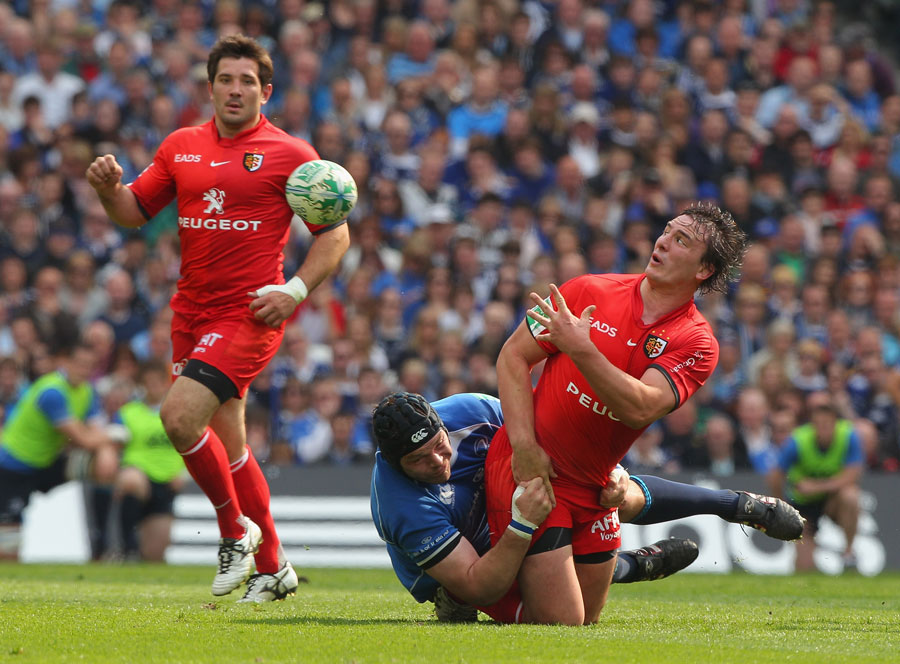
Leinster vs Toulouse - A fixture of the past?
And before Irish, Scottish and Welsh fans start arguing about playing populations and how economics means they can’t support more than a few professional teams so they need automatic qualification, this is elite sport, not a charity. The premier European rugby competition needs these teams from the Celtic and Italian nations, but not at the expense of fairness.  

As if to give validity to the whole argument, along come Zebre. This is the team that has replaced Aironi in the RaboDirect competition. They are an unknown quantity and chucked together when it became clear that Aironi could not financially operate as a club anymore and the Italian RFU decided they wanted more control over their teams. ‘Give them a year in the Amlin’ I thought when I heard of this new side in the competition. That would be the sensible option. Let them have a year to find their feet and look on from there. Boost up a team to the big competition that missed out narrowly on qualifying last season like Stade Francais or London Irish. That would be the right thing to do.


Zebre are in Pool 3 of the Heineken Cup. If this is how European rugby wants to operate, then maybe it can carry on in a competition without the likes of Toulouse and Leicester Tigers. Let’s have a competition between the top French and English sides if they won’t accept a smaller tournament with just the top six RaboDirect qualifying. As much as I loved Swansea, given the choice between the South of Wales or the South of France, there is little debate in this household. Such a competition has a future, the other does not.

And what is the Heineken Cup without the French and English teams? A Celtic League with a couple of Italian sides thrown in and I’m pretty sure we already have one of those. We can work together for a better and fairer European Cup or we can allow this separation of views to become a genuine division that benefits very few.

Monday, 8 October 2012

Ross Ford: Eternal Optimist


“We can beat the All Blacks” A massive statement from a man whose team collected the wooden spoon in this years 6 Nations. Maybe it’s the whiskey fumes, or Edinburgh’s lofty success in the Heineken Cup last year, but Ross Ford has certainly put his neck out on the line.

A statement of this magnitude is backed up by the imposing figure of Ross Ford, however it’s going to need much more than one man’s words to beat the All Blacks.  Scotland played well in patches at last year’s 6 Nations and the emergence of David Denton alongside strong performances from Richie Gray and Sean Lamont will provide some comfort for the stats at the end which read played 5, lost 5. The last time Scotland weren’t in the bottom two was back in 2005-2006 when they achieved a 3rd place finish on 6 points. A 13-6 loss to Italy in the last game of the 2012 Six Nations condemned them to one of their poorest six nations to date and makes Ross Ford’s recent statement laughable. How can a team languishing at the bottom of the six nations have any chance of beating the world champions?

I appreciate the element of positivity in Ford’s comments and belief is a key factor in any sport you play in. A 9-6 victory against Australia cemented a successful summer tour and provided the Scottish team with some hope for the November tests. Their counterparts New Zealand secured the Rugby Championship a round early and finished off a very successful competition comprehensively beating South Africa 32-16.  Steve Hansen has claimed there’s still room for improvement in his All Black side and this will surely strike fear into all the rugby nations facing the All Blacks this autumn.

The All Blacks thumped the Scots 49-3 the last time the teams played and they will be looking for a repeat performance this time round. Looking at both sides Scotland will have to target the All Black forwards if they are going to stand any chance of an upset. I really rate the Scottish pack and feel for many years they have been let down by a poor backline. Players including Euan Murray, Ross Ford, Richie Gray, David Denton, Kelly Brown, John Barclay and Alistair Kellock have the potential to be world beaters but are they going to do enough to stop the power and pace of the All Blacks?

The main problem for the Scots is their fly half. They have lacked dynamism from the 10 spot for many years and players like Laidlaw and Weir are just not good enough to make an impact on the world stage. Cusiter and Blair combined with the Lamont brothers and Visser are all good players but if they’re not getting the service then their impact on a game is minimal. The Scots must ensure they get parity in the forwards if they stand any chance of scoring points against a well drilled All Blacks side. 
On top of this their defence will have to be as strong as it’s ever been to deal with the direct running of players like Nonu and the skill and invention of Conrad Smith. The All Blacks harness the power to score tries from all over the park and with people like the Whitelock brothers epitomising the modern day athlete they will have to shut them down at the earliest opportunity. I really can’t see anything less than an All Black victory in every game they play in the November Test series. I don’t feel any of the home nations offer enough at the moment to trouble the All Black regime.

Ross Ford: I admire your commitment and dedication to your country but I’m going for a victory for the All Blacks by 40 points or more!

Thursday, 4 October 2012

Danielle Waterman dishes out the boom


Danielle Waterman has been tearing up the international rugby scene for a few years now. Her hard running, great feet and her ability to pick a line has made her a full-back of the highest order. Only she could style out a knock on.

Lets get this right, the Aussie substitute deserved it. If you are going to run into someone after the whistle has blown and don't make any effort to decelerate you have to expect a reaction. The obvious difference in power did make it look a little bit like seal clubbing but I have nothing but admiration of how she dished out some 'sit-down' on the unsuspecting chaser. 

Danielle Waterman, take your seat next to Ben Morgan as one of this blogs favourite players. 


Thanks to rugbydump for the video.

RGN Welcomes James Durward-Akhurst as Co-editor

Some of you may have noticed the much higher standard of articles recently being added to the blog. I wish I could take the credit for said articles but in actual fact it was my old pal and long time rugby geek James Durward-Akhurst.

James was a star of the Queen Elizabeth Boy's School 2nd XV from 2000-2002 and his lack of consistency in playing over the past years has been the sport's loss. However this has given him the opportunity to watch A LOT of rugby on the telly. This has made James' encyclopaedic knowledge of the game a wisdom to behold and he regularly stumps me with interesting facts and insider knowledge that only the most connected of people could possibly know. As a result of this, I have reported him to the Leveson Inquiry but apparently they were not interested.

So I'm pleased to announce that James has agreed to become a co-editor for RuckingGoodNews meaning we can look forward to his contributions for some time to come.

One final thing, James thinks he's the dead spit of Sonny Bill Williams. I agree wholeheartedly but you can judge for yourself.

Co-Editor James Durward-Akhurst (left) and Founding
Co-Editor Ross McKenzie (right)

Tuesday, 2 October 2012

Rise of the Chiefs

The Exeter chiefs are fast becoming one of the most forward-thinking and fan-friendly clubs on and off the pitch and with plans to develop their already excellent set up they are showing they have the credentials to operate on the big stage. Exeter enter their third year in the Premiership having gone from strength to strength. Premiership survival has since been eclipsed by narrowly missing out on a top 4 finish and with players like Tom Johnson getting international recognition the Chiefs are showing the Premiership they mean business!

Off the Pitch
Funded by their Chief Executive Tony Rowe, the Chiefs have seen a complete transformation over the past 12 years. The days of playing at the County Ground have long been forgotten with the ever impressive Sandy Park. Sitting mightily above the M5 the £15 million purpose built 10,500 seater stadium is one of the best grounds in the Premiership. Add to that the expansion plans submitted to double the capacity of Sandy Park and you start to see Tony Rowe’s blue print all those years ago.

The Exeter story is even more impressive as many sides struggle to survive their first year in top flight rugby due to the constraints placed upon them by the RFU. The £1.2million central funding given to the promoted team is almost half of what the other clubs earn in the Premiership. This hardly levels the playing field for a team who have just worked so hard to gain promotion. It is clear Exeter used the money wisely. They invested in international players such as Ignacio Mieres, Sireli Naqelevuki, and Jason Shoemark whilst also tying down their English contingent notably Tom Johnson, Matt Jess and crowd favourite Chris Budgen. Rowe also utilises Sandy Park for business ventures outside of rugby which added to the central funding figure has made survival more manageable. A state-of-the-art conference and banqueting centre sits proudly on the site alongside a newly developed gymnasium complex.  


On the Pitch
Success off the field has also been matched on the field. A highly successful coaching team and squad have been assembled and it has operated at the highest level from day one. If a 22-10 victory over Gloucester in their first game wasn’t enough to convince the rugby world that Exeter meant business. a narrow loss to Leicester Tigers at Welford Road where they scored 27 points certainly had heads turning. Victories over Saracens and Northampton also followed, which heralded one of the best seasons for a newly promoted side. The following season, Exeter continued their good form and were unlucky not to finish in the top 4, narrowly missing out to Northampton Saints. Tom Johnson received a well deserved international call up and players like Matt Jess, Haydn Thomas and James Scaysbrook put their markers down for international inclusion.

Fast forward to this season and with inclusion in the Heineken Cup the Chiefs are still moving in the right direction. Add Australian second row Dean Mumm to the equation and on paper they are a very tough side to beat. A thumping win against a strong looking Sale side was followed by 2 narrow losses to Northampton and London Welsh. They have since bounced back with a victory over Saracens and a loss to Leicester. A mixed bag of results you might say, but performances from the likes of Matt Jess will have Stuart Lancaster thinking very hard about any changes he will make to his EPS squad. 

The Biggest Test Yet
I would also point out that I feel continued success could come at a price this season. Despite the obvious positives happening at Sandy Park I would say that this season will be the measure of Exeter Chiefs. They have been remarkably lucky with injuries over the past few seasons and without large volumes of international call-ups they have fielded a largely unchanged side week in and week out. With added fixtures in the Heineken Cup and LV Cup along with key player/players missing for the November Internationals and Six Nations it is going to be a very long season. Look no further than their fixtures starting from 23rd Sept. Saracens at home, Leicester away, Harlequins at home, Leinster away and then Clermont at home. Add to that a popped rib cartilage for Tom Johnson and you start to see how consistency may falter. 

I am sure each and every player and coach will give 110% in every game they play, but I feel Exeter must be realistic and target success where it is most achievable. I would love to be proved wrong but I cannot see them beating Leinster and Clermont home or away which automatically rules them out of the competition. We all know Chiefs are destined for success, so use the Heineken Cup as a building block to give players experience of playing on the biggest stage. Use the LV Cup to blood the academy players and concentrate on a top 4 finish in the Aviva Premiership. 

Monday, 1 October 2012

Saracens: Killing the Game or Masterful Tacticians?


After 4 rounds Saracens are sitting pretty in the top four of the Aviva Premiership although the term ‘pretty’ couldn't be further from the truth. Boasting an English backline including Ashton, Strettle, Goode and Farrell Sarries have gone a full 260 minutes without scoring a try.....Cue Brian Moore!

The outspoken Moore says Saracens players are being ‘straitjacketed’ which will have negative repercussions for the national team. It pains me to say it, but Moore does have a point. However, I would also add that despite the negativity surrounding Saracens’ style of play, they must be congratulated on a brand of rugby which although not ‘pretty’, wins games.

"Offense sells tickets; Defense wins championships".

The above quote is from Paul ‘Bear’ Bryant regarding the NFL but how apt is it to describe Saracens Rugby Club. Measly attendances at Vicarage Road regardless of the opposition coupled with a defence which won them the premiership in 2011 and continues to deliver big ‘W’s’ week in, week out.

We all want to see attacking flair on a rugby pitch, tries being scored and copious points being accrued. But would you accept this brand of rugby over a victory? You need to ask yourself, would you prefer a 51-50 loss in a game of open attacking rugby, or a 3-0 victory clouded by rucks, mauls and close knit defence? It’s not for me to answer for everyone, but in my honest opinion, it’s got to be the victory. 

Saracens have found a battle-hardened spirit
through some 'team bonding'
Last year’s Premiership final saw the two best attacking teams, Harlequins and Leicester battling it out for the champion’s crown. Heralded as a ‘thrilling final’ Harlequins took the prize 30-23. Leicester will find no consolation in knowing that people enjoyed their style of rugby on the day. They will have wanted a win and I’m sure Cockerill would have gone to any length to get that.

Will Greenwood as a player and a pundit has my utmost respect and I value his opinion whole heartedly. He commented that the weekend’s game against Harlequins was like ‘Ying and Yang,’ and he was spot on.

“Saracens won the Premiership in the 2010-11 season with a style of play that was all about percentages, about turning the odds to their favour. The coaching staff decided that they were going to be the most efficient, least error-prone side of the year. If they could do that, the thinking went, then they would probably also manage to win the most games.”

“The pitch was split into zones, attack and defence had to work to a well laid out set of rules, players knew their roles, their positions, their expected reactions. Plans were best-laid, counter attacks were broken down into risk rewards, and more often than not players deciding that a kick was better than a run. “

It baffles me that a team who has the ability and expertise to shape a game in their favour and ‘squeeze the life’ out of teams gets so much criticism? It’s clear from Greenwood’s quote how much hard work goes into the training at Saracens and innovative approaches like individualised iPads for match analysis adds further weight to this argument. Conor O’Shea admitted in defeat “It became the game they wanted in terms of flow but that's a credit to them.”

I take my hat off to the ever consistent Leicester Tigers whose attacking style of play has seen them appear in 8 consecutive Premiership finals. Add to the mix the more recently rejuvenated Harlequins and Northampton and you have good value for money rugby. I would just like to remind people of the Brighton trip that Saracens went on late on in the 2010 season. They came back fully rejuvenated and played an attacking brand of rugby everyone wanted to see.  They defeated Northampton at Franklin’s Gardens in a pulsating game and showed the rugby community that they too, could mix it with the best.

For anyone who disputes Saracens’ attacking ability, just watch the video below. They may not score many tries, but when they do.......they’re pretty special.


I’ll go back to my original conundrum: Killing the game or masterful tacticians?

The answer lies in the fact that we know Saracens can play attacking rugby when they want to, yet they also harness the power to dictate games with their own style of play. Once again, like it or loathe it, it works and Saracens’ coaching and technical staff should be commended on the work which goes on behind the scenes to prepare the team for the big games. In my eyes, blinkered or not, they are masterful tacticians. 

Article from James Durward-Akhurst